India has a large number of educational institutes, and yet our graduates are not qualified to get hired. I know, I am not sharing anything new. We all have read this enough times – educational degrees are strong on paper but fail miserably when it comes to making candidates industry-ready.
I am not going to waste my time and yours going through this again. What I want to do instead is share another perspective on this challenge and how music and art education can intervene.
I feel we have built an education system which fails miserably when it comes to building two apparently contradictory values – curiosity and expertise. If we want to become even more analytical, I would say our education system does a slightly better job at building expertise than building curiosity. I remember my college days – especially the 9 pointers- being very good at solving problems from the textbooks and scoring marks but lacking curiosity about anything else. Many of them got good jobs through placement, but they did not flourish beyond a point, partly because they lacked curiosity.
We are being grown up in a society, which includes family, schooling system and other spaces of interaction, where expertise is valued way more than being curious. The curious person is assumed to be an amateur, whereas an expert is believed to be the one who has already reached the top of the holy mountain – who knows it all and need not possess any form of curiosity.
As we start growing up, most of our immediate role models show a lack of curiosity. For instance, in my school, my teachers were the most experienced individuals in front of me in that phase of life, the principal being the epitome of expertise. I still vividly remember the principal of the government school where I studied when I was in grades 2nd to 4th – putting sun glasses on his eyes while walking through the dingy corridors hurriedly, without being curious about anything.
“That’s how people at the top are – they know everything and hence are not curious about anything,” I wondered.
The Day My Guru Stopped Teaching Me
Many times, curiosity also gets punished. I remember, when I was 13 years old, my father was transferred to Amravati – then a small town in the Vidarbha region of Maharashtra. I was learning to sing under Kale Guruji – a very respected music teacher.
One day, my father, who had recently returned from Nagpur – a larger town which had big shops selling music cassettes, bought a cassette of Pt. Bhimsen Joshi. While listening to the cassette, I spotted one part where Bhimsenji had sung a note which was supposed to be ‘varjita’ (omitted) in that Raga. Out of curiosity, I took the cassette to Kale Guruji and requested him to listen to it and tell me if he did use a note which was supposed to be omitted and was it deliberate or a mistake.
He got furious.
“How dare you find mistakes in Bhimsenji’s singing? We are finished. Do not come to class from tomorrow,” he told me, shaking with anger.
I am sure most of us have paid some price sometime for being curious in our lives. And then we complain we do not have talent ready for industry. Industry demands curious expertise. Expertise that can spot gaps and apply itself to bridge them.

I told this to my mother, and she took me with her to Kale Guruji. She made me apologise, and she apologised to him herself.
He remained adamant, and my learning stopped.
Back home, I got another serving of anger. “Why did you do it? Why can’t you keep quiet? Why do you always need to ask such questions?”
I am sure most of the children have paid some price for being curious sometime in their lives. And then we complain we do not have talent ready for industry. Industry demands curious expertise. Expertise that can spot gaps and apply itself to bridge them.
How can we build curious expertise in our children as they grow? It’s a much larger challenge with many possible answers – from what parents and teachers can do in their classrooms to what kind of policies and institutional shifts we need in place for the same. Instead, I am going to share how my music practice allowed me to create a space where curiosity and expertise can coexist.
The hundred faces of a Raga
The journey of learning Khayal Sangeet is intertwined with learning Ragas. On one level, a Raga is very simple – just five or six notes with some rules, but as you start going deeper, you start to see the endlessness of Ragas. When I was earlier learning from late Pt. Vijay Sardeshmukh and even today, as I learn from Pt. Vivek Joshi, I feel the only way to master a Raga is developing this blend of curiosity and expertise. The Guru will make you repeat some phrases hundreds of times to build your expertise and at the same time, one day, he will sing a composition in that Raga which positions the notes in such an unexpected way that you find it hard to believe it’s the same Raga. While training under both these Gurus, I realised how beautifully they built my expertise and kept my curiosity afire simultaneously. You master a Raga only when you have seen at least a hundred of its faces, which happens only if you are curious.
Learning from the legends
In the world of music, one will find both kinds of role models – some who were just experts and some who were curious experts.
“I realised how gigantic the form of a Raga can be when I saw shipbuilders building mammoth ships at the Mazgaon dock,” said Pt. Kumar Gandharva in one of his interviews.
Or a book by Sheila Dhar describes celebrated Sarangi player Bundu Khan lying in grass, facing the sky, with his Sarangi on his stomach – trying to absorb the wonders of nature through his tiny eyes and reproducing them through his Sarangi.
Or Ustad Bade Ghulam Ali Khan – the one who watched fish in the water for hours, trying to mimic their movement through his voice. Khansaheb would get drenched in tides at the Marine Drive trying to answer each tide with his impromptu taans.
As I kept my eyes open, I found enough musicians who were curious experts and inspired me to walk on their paths.
Music making is about building bridges
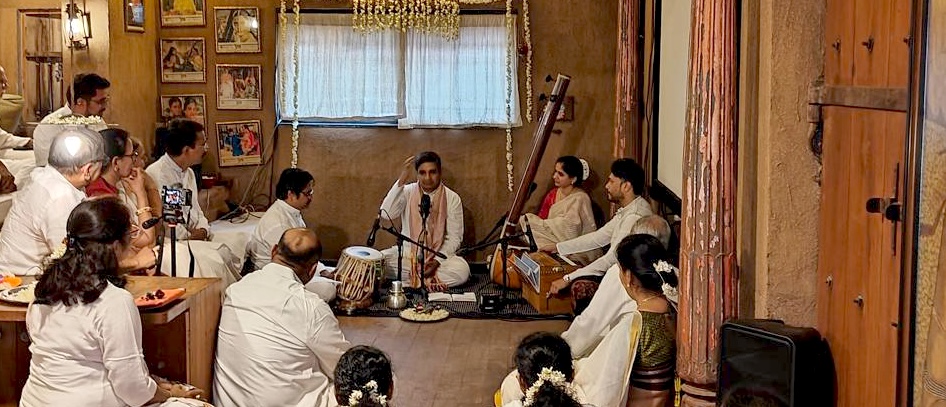
Whenever I sing, I try to build a bridge between me and the audience. To achieve this, one has to be very open and curious. While many musicians simply present what they have learnt over years without bothering about how it is affecting their listeners, I am in a very curious state while performing.

For me, music eventually spills over into human nature and behavior. I feel as much as I need to have musical expertise, I need to be a curious observer to be a better musician.
I observe how people react to a particular phrase and at what point they start losing their attention. For me, music eventually spills over into human nature and behavior. I feel as much as I need to have musical expertise, I need to be a curious observer to be a better musician.
Getting hijacked by curiosity
The one thing I absolutely follow after every concert is coming back and listening to the full recording of the concert before I sleep that night.
Many times, the concert gets over at 11 at night, which is followed by catching up with the hosts and the audience over an elaborate dinner. Even if we reach home at 2 AM, I do not sleep without listening to the recording. Rather, I ‘cannot’ sleep without listening to the recording.
Why? Because of my curiosity.
Curiosity about what all went wrong and what went well. How did a phrase, which I had never thought of, but sang almost instantaneously, actually sound? Were the Tanpuras tuned throughout, or did they diverge somewhere in the middle? There are so many things, which if I do not reconcile within my head, I cannot sleep no matter how hard I try.
You know another thing?
I find falling asleep the night before a performance equally difficult. Not because I am nervous but because I am excited and curious. Curious about what all is going to unfold. Curious about talking to my accompanists if we have to travel together to the venue. Curious about who all will show up and how well I will be equipped to reach them through my music.
Not every music teacher will encourage her pupils to be curious, but I feel music creates a parallel world where you can live on your terms. Just as Beth Harmon (Queen’s Gambit) finds a full world unfolding on a chessboard, I found a whole new world in music. A world in which I can be an expert and curious at the same time!

About the author
Mandar Karanjkar is a co-founder of Baithak Foundation. He is a Hindustani classical vocalist, a composer, and a communications consultant. He has authored 4 books and has given 3 TEDx talks.
Mandar also conducts trainings and capacity building workshops for corporates as well as not-for-profits.
Leave a Reply